About a month ago, planning our return to Montenegro we picked Pluzine, a town half way between Sarajevo and Kotor, as a good place to find a bed along the way. Expedia is where I usually look for single night accommodations and so it was this time. I typed the name of the town in the search box, found a satisfactory option, confirmed its location on a map and booked it.
“Man plans, God laughs” goes the common saying.
Kamp Grab, as the place was called, turned out to be about a 40 min ride away from Pluzine. Not only that, but it ended up being half way between the Bosnian and Montenegrin border checkpoints — quite confusing to put it bluntly — and some 10km down a narrow mountain road following Tara river into the unknown. Well beyond out of the way.
And?
It was fantastic.
Our ride through the Dinaric Alps along the Bosnian-Montenegrin border was an overnight weekend outing rather than the return to Kotor that we originally planned. In this context, our remote night accommodations were easy to accept as a part of the adventure rather than an undesired complication and delay.

Kamp Grab marked with the red pin above.
With just one weekend of riding left before my hand surgery, the contour lines and canyons less than 3hrs south of Sarajevo were just too tempting this first weekend in July. An explorer’s catnip, really. A chance to explore new roads in both Bosnia and Montenegro? Impossible to resist.
It was about 18C at 9am when we were leaving Sarajevo on Saturday morning, but with the sun out and not a cloud in the sky it felt warmer. Knowing we’d hit 25C later in the day I debated whether to put on the summer mesh jacket like Min, but opted for the Basilisk I’ve been wearing since Milan, with all the ventilation zippers open. It ended up being a coin flip. We were both comfortable most of the day with just a t-shirt and a Plasma vest underneath. Min thinks the low speeds helped to keep her warm in the morning, but the 40-70km/h we rode most of the day was also enough to drive enough air through my vents when the temperatures hit 27C in some pockets.
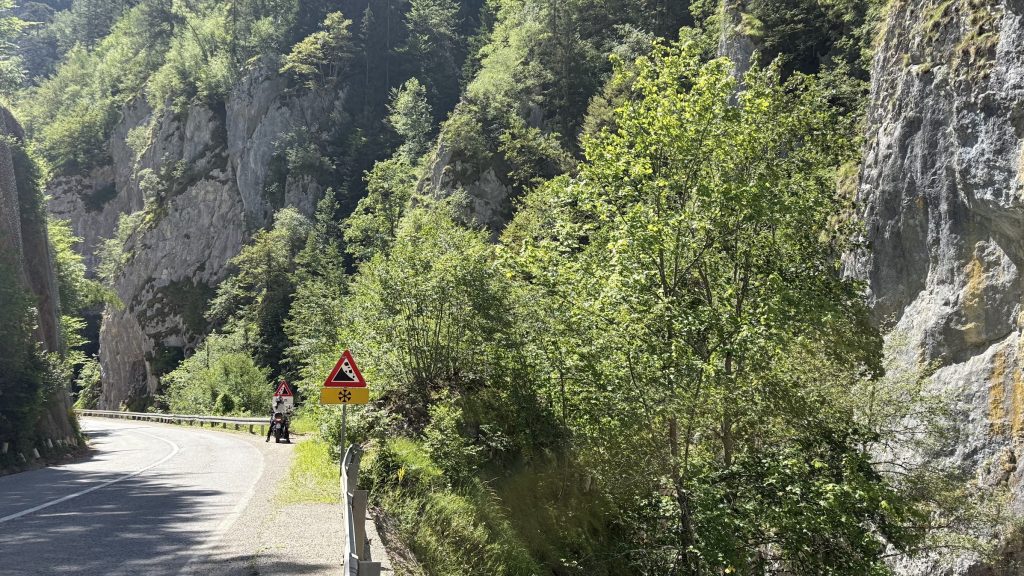
Highway M18 south from Sarajevo
The scenery south of Sarajevo builds up a bit like an American movie. After a brief intro there’s a hook — vertical cliffs along a rocky mountain river, then a lull of rolling hills with a slow build up toward a wild finale of much taller Dinaric Alps around the Montenegrin border. All of it is riding country. The road follows a succession of several small mountain rivers twisting and turning as it must to keep up. Around Foča, Bistrica, the last of the small rivers falls into the much wider Drina. Confusingly, Drina flows north away from the Adriatic just a hundred kilometers west. I traced its flow on a map just to understand why and was shocked to find that it is a tributary of the Danube draining into the Black Sea, hundreds of kilometers on the other side of the Balkan Peninsula in Romania. The Dinaric and Albanian Alps split the watershed between the two seas.
As for Foča, it’s an ordinary town, much of its character deriving from the tall riverbanks of the Drina. We drove in looking for sustenance, failed to find any at a couple bars overlooking the river and ended up with a gas station pizza on the way down. We had much better luck on the way back. Antik, a restaurant overlooking the the bridge over the crystal clear Drina on M18 has a great, well shaded outside terrace and great breakfast choices.
Foča is pretty much the last chance to refuel 45min north and south of the border. Not knowing what to expect ahead, we filled up and continued up river along Drina toward the border. Within a few kilometers M18, despite being relatively well traveled this time of year, turns into a low category country road complete with uneven tarmac and wide, make shift gravel and pothole shoulders. Most vehicles here move cautiously at about 30-40km/h, the exception being the passenger vans delivering tourists to rafting easements. They terrorize the rest going about 10-20km/h faster and are often to be found in the middle of a tight blind turn.
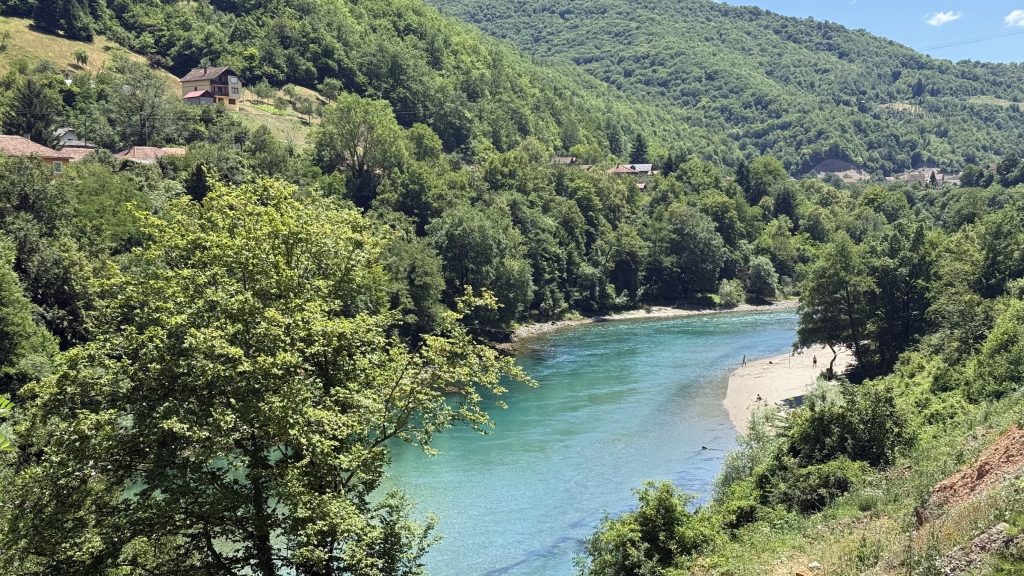
Drina River just east of Foča
The country here is beautiful. The mountains which are already pretty tall around Foča keep gaining altitude the further south one travels and Drina mesmerizes with its blue green clear waters. On the Bosnian side, much of the east bank of the river is developed into river cabin and rafting resorts. Packed this time of year, but far from bumper to bumper traffic.
Eventually, Drina splits into two tributaries — Tara to the east and Piva to the south. About 200m east of where the three meet lies a wooden bridge where Tara delineates the border between the two countries, once both a part of Yugoslavia.
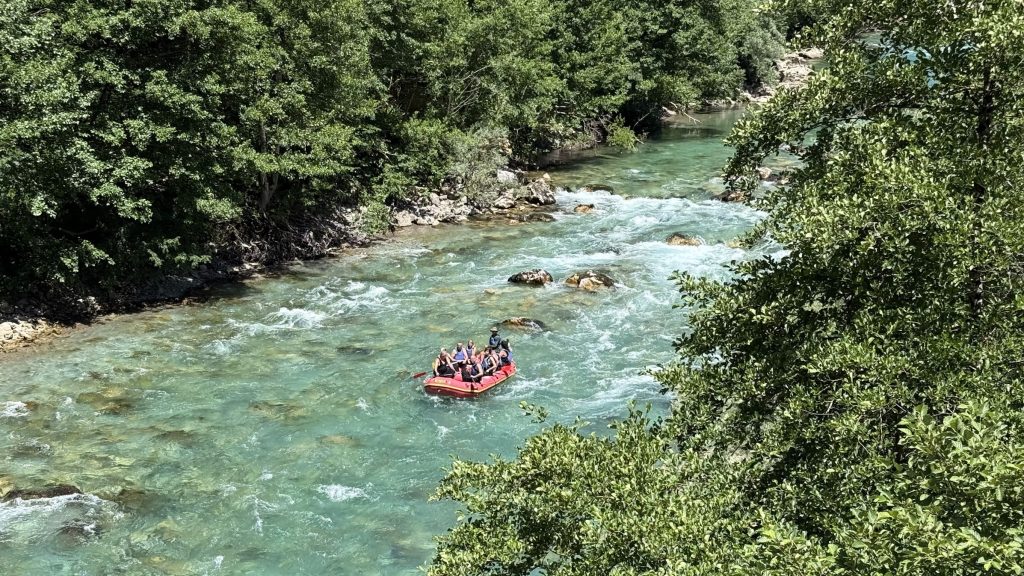
View from Tara River bridge, Bosnia-Montenegro border.
This is probably the most beautiful border crossing I’ve ever seen. The area sits close to Durmitor National Park in Montenegro, but the landscape within a 30km radius, and perhaps more, is already of national park quality.
Then come the checkpoints.
On the Bosnian side the crossing resembles a Federales army security check one may encounter in the middle of the Baja peninsula in Mexico. Barely a booth, no need to bother with a passport. They just wave everyone through. Well, going south at least. Going north they did glance at our passports, reluctantly.
On the Montenegrin side it’s a different story. Depending on the time of day and direction — going north looked worse in our experience — the crossing can take a while. Approaching the border we came across a European Union welcome sign that had me in a panic for a second before I realized that it was put in place in anticipation of the country being welcomed into the block in the not too distant future. We’ve been conserving Schengen days for August so entering the customs union now would rob Min of a couple days in Italy this fall. The crossing itself is a bit of a mess, much of it — hate to say it — thanks to our fellow bikers cutting in line ahead of cars. Getting ahead of cars at the traffic lights in Europe is one thing, bikes are long gone before the cars hit 5km/h, but at a border crossing each bike represents at least one passport. No logic in the privilege unless we’re talking about a single biker skipping ahead of a bus of 50 passports. A group of 3-7 bikes skipping ahead of 5 cars? Not so much.
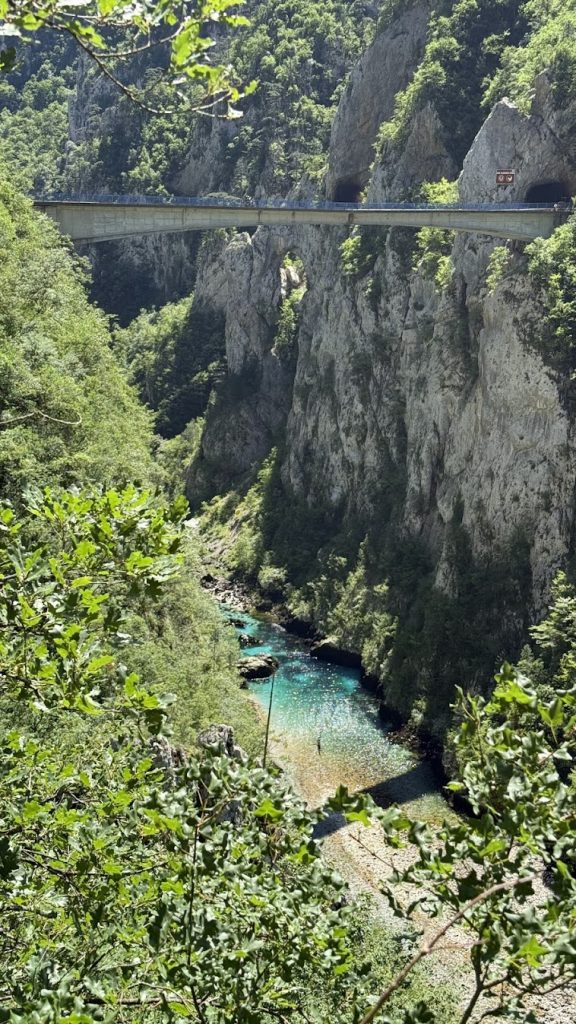
Bridge across Piva River, partially dry south of the dam.
South of the border, on the Montenegrin side, the ride along Piva River turns quite dramatic. Vertical rock formations on either side, countless mini tunnels and a narrow stream some 30 or more meters below.
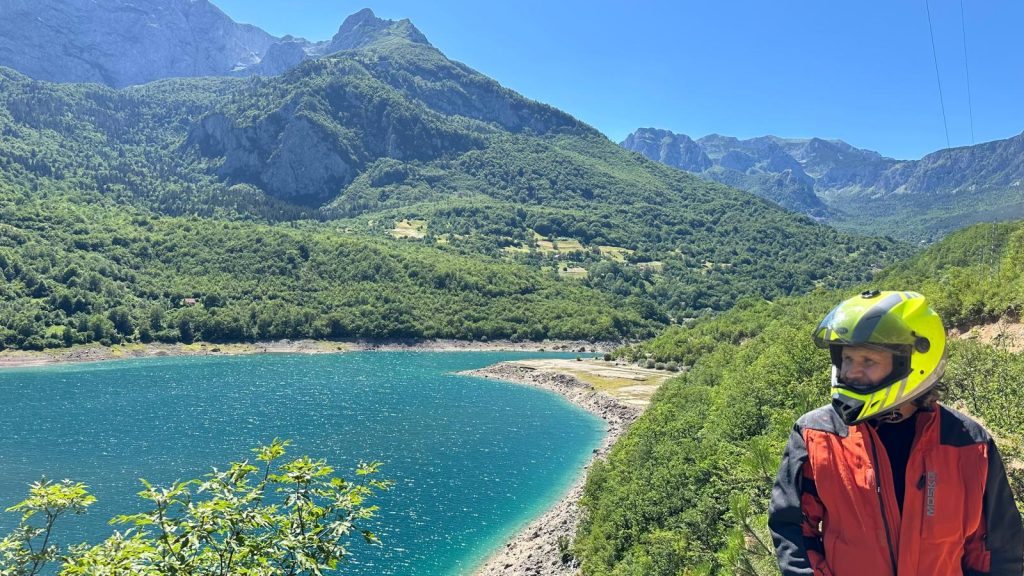
We stopped several times just to take in the sights, then continued on south of the dam.
Piva Lake
Here the river is rechristened Piva Lake as the waters rise up and fill up the rocky canyons. Right at the dam there’s a road that ends up nowhere in particular to the west while the main road continues south. We explored both.
Once we had our fill of the canyons we turned around and headed back north. My cell data coverage was a bit spotty most of the trip, but earlier in the day I managed to pull up Kamp Grab’s website and I realized that it was nowhere near Pluzine. Not only that, but getting there would be an adventure.

In my mind, raised behind the Iron Curtain and now living in the land of the somewhat free, border crossings can be pretty serious business. But, as confusing as a Slavic reality may sometimes appear to a rule-loving westerner, it’s often all about common sense. Fortunately I still had a bit of it left when we returned to the Šćepan Polje crossing a couple hours later to access Kamp Grab. We ignored 2hrs worth of cars and motorcycles waiting to leave Montenegro and passed by the barriers without as much as a glance at the booths. We weren’t leaving the country after all, we were simply going to a camp which just happened to be only accessible through a road between two border checks. In our multiple Balkan crossings I’ve realized that most border officers only speak enough English to be able to communicate the essentials. Try talking about anything else than your documents, destination or length of stay and you get a blank stare. You could choose to sweat in line for a couple hours and then try to explain why you don’t need an exit stamp or you could just cut across and go. No, this wouldn’t fly in East Berlin 40 years ago, but here it worked like a charm. Let’s call it a calculated risk. I had 40 minutes to observe this particular border culture two hours earlier.
Around 4:30pm, some 7km of tarmac and 2km of gravel later, we descended down to Kamp Grab, a mini weekend paradise on the banks of the calm, but fast flowing and beautiful Tara River.

All Expedia’s sins were immediately forgiven. If just a sliver of the site’s inaccuracies resulted in such finds I’d use it to plan all our stays.

The camp had everything anyone would need on a summer weekend. Camp spots, cabins and a well shaded open air bar-restaurant in the deciduous forest overlooking a sand and boulder beach along the river.

We could even park the bikes where they were fully visible from our 1st floor wooden cabin balcony. The other campers were a mix of hikers, rafters, bikers and off-roaders, groups of 2 to 20, from all over Europe. Even heard a couple speaking Latin American Spanish. A larger group of close friends from the capital Podgorica turned out to be the most alive singing along to Spotify late into the night but somehow never disturbing those of us sleeping just 100ft higher up the hill.
Min leaving Kamp Grab on Sunday.
We could have easily spent a whole summer month here.

Looking forward to hearing your stories!

Wow, looks amazing! I’m so happy “God Laughed.” The Drina & Tara River are stunning. The Piva looks about like the Rio Grande right now. Man, it’s pretty rough here this summer… hot, hot and more hot. I thank my lucky stars I’m not working outside this summer, like I did when I first moved to NM. I don’t think I could handle this relentless heat. I hope your hand surgery went well and you are recovering with ease. Looking forward to hearing more, miss you guys! <3
Leave a Reply