

Sunday morning, at agrotourismo
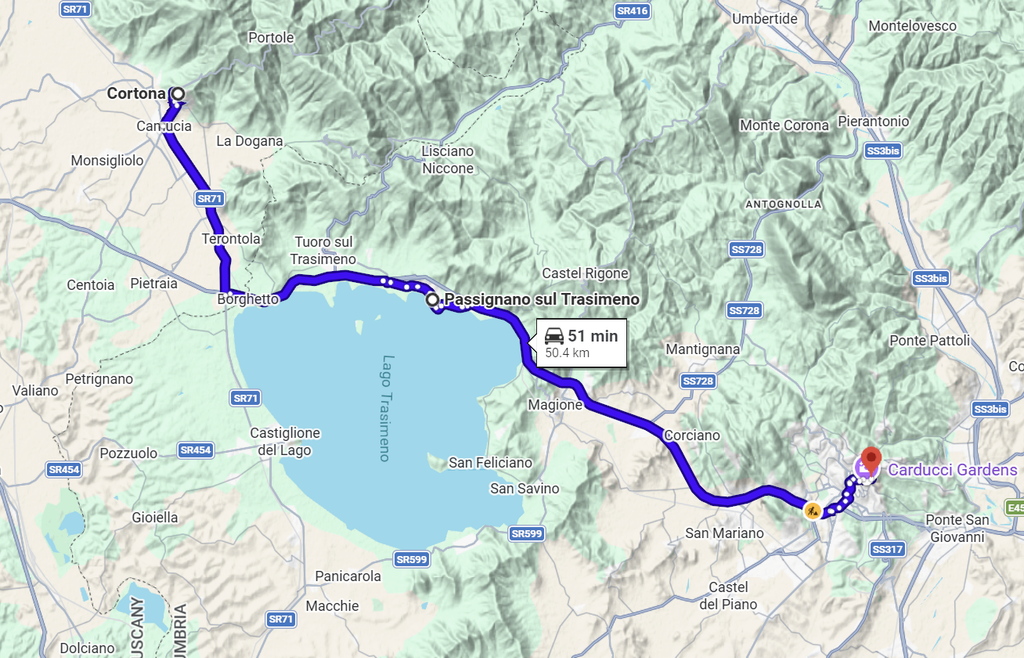
Cortona lies at the southern edge of Tuscany so it was only minutes after breakfast on Sunday that we found ourselves riding through Umbria. Rather than east, the quickest way to Rome, we headed west, to Perugia, the region’s capital.

Our first waypoint was a large blue splat on the map sitting comfortably right next to the shortest route — Lake Trasimeno. We knew nothing about the lake and selected the path solely for the potential variety.

The lake wasn’t as visible from the highway as I had hoped, but we did get a grand view of it when we pulled off the autostrada for a few minutes to ride through the town of Passignano sul Trasimeno. Given its positioning and the recreational amenities, it was clear that the town receives a fair amount of traffic in the summer months. Umbria is only one of 5 of Italy’s 20 regions without sea access of its own. Conveniently, Perugia is only another 45 min away.
The autostrada that took us to and from the lake was of lower grade than the A1 around Florence, but served a similar role offering a traveler a pretty good sense of the countryside. With no claims to the Renaissance, Da Vinci and Dante, Umbria comes across as more humble and down to earth than Tuscany. The hillside villas aren’t quite as polished, overall sense of order and cleanliness a bit more relaxed. One has the sense of entering central Italy where spontaneity begins to displace function. Form, as everywhere else on the peninsula, retains the highest status.
We continued on reaching Perugia just in time for the morning’s second coffee.
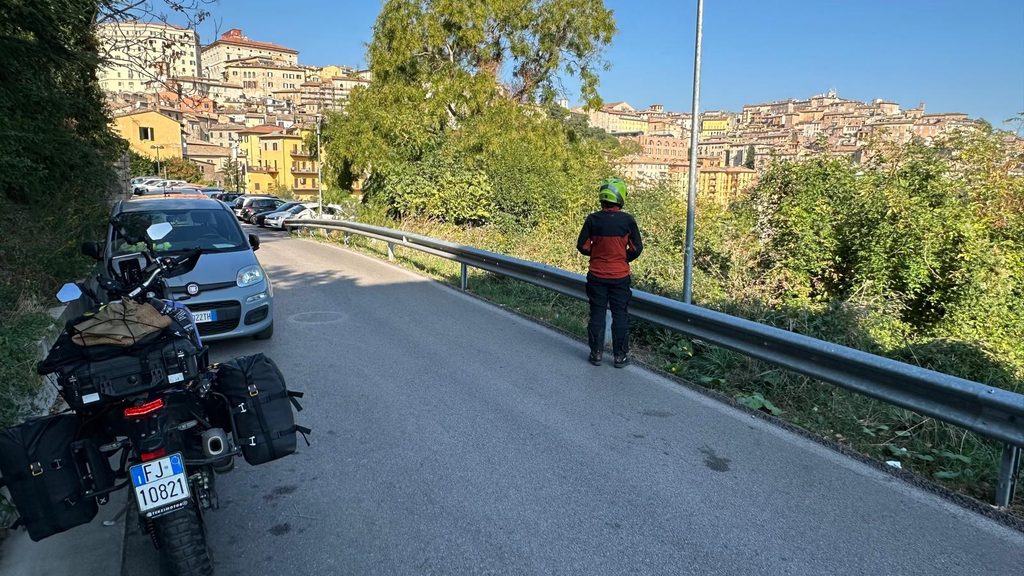
With a population of over three hundred thousand, Umbria’s capital dominates the countryside from up above. There are endless ways to scale the hills to the historic center and just as many to get lost. The heart of the city was harder to pinpoint than usual and even trickier to find a cafe with nearby bike parking. At one point Google tried to send us not only the wrong way, but up a set of stairs.

As a second generation chocoholic, I had an additional motive for visiting this city. Perugia is the home of the hazelnut flavored Baci and its mother brand, Perugina. In other words, this was a pilgrimage. Unfortunately, well before noon on Sunday, the odds of finding an appropriate chocolate altar were rather low and so we were on our way again shortly.
Leaving Perugia with our compass pointed southwest to Orvieto we had several paths to choose from.

SS317 would have been probably the most interesting of the three options (middle, unmarked above), but Min felt we had exhaused our hairpin turn allowance for the weekend the day before. It would have also added an extra hour to the trip. And so we chose E45 and SS448, the most easterly of the three instead. The thinking was that it would leave us with just enough energy at the end of the day to deal with Rome’s mega polis traffic. A decent stretch of the route ran along a lake as well.
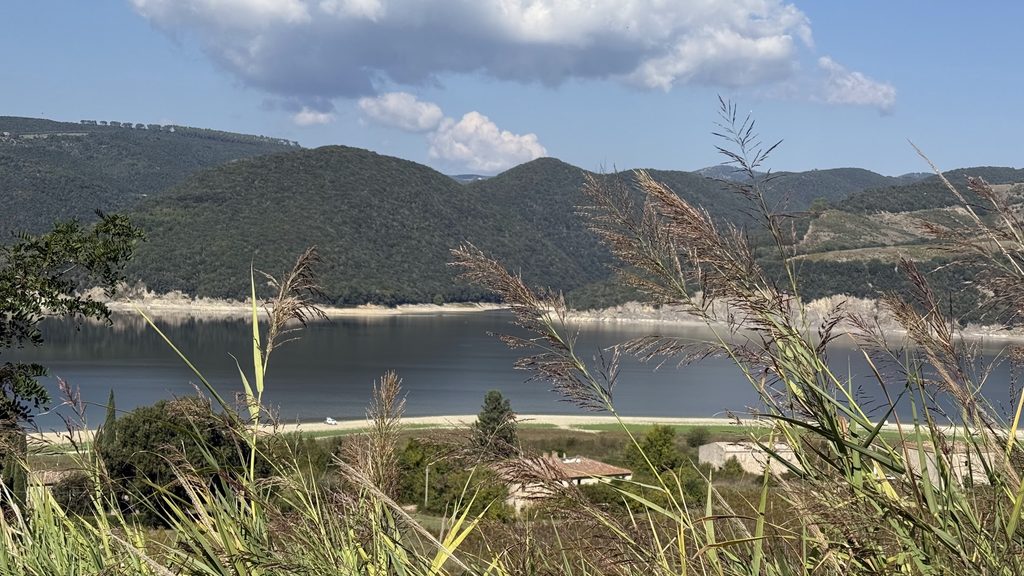
As expected, our chosen route was neither well travelled nor particularly technical. Relaxing as a segment within a larger journey, but not something I’d chose to ride every weekend. Lago di Corbara above.
But the highlight of the day wasn’t the journey nor the final destination. It was Orvieto.
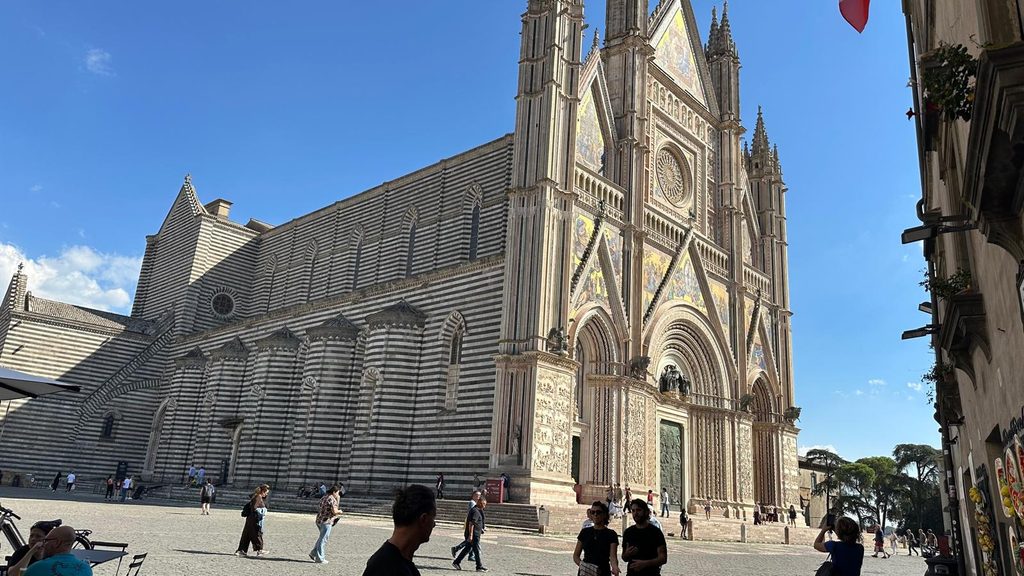
Orvieto’s 13th century Duomo.
The first taste of the city comes as one approaches from below. In our minds, Orvieto immediately drew comparisons to Erice, the stunning, little known town two hours west of Palermo we visited back in March. Unlike its Sicilian kin, which felt like an open-air museum with few signs of life, Orvieto came with a 13th century Duomo and a restaurant scene to meet the demands of the tourist traffic originating less than two hours south in Rome.
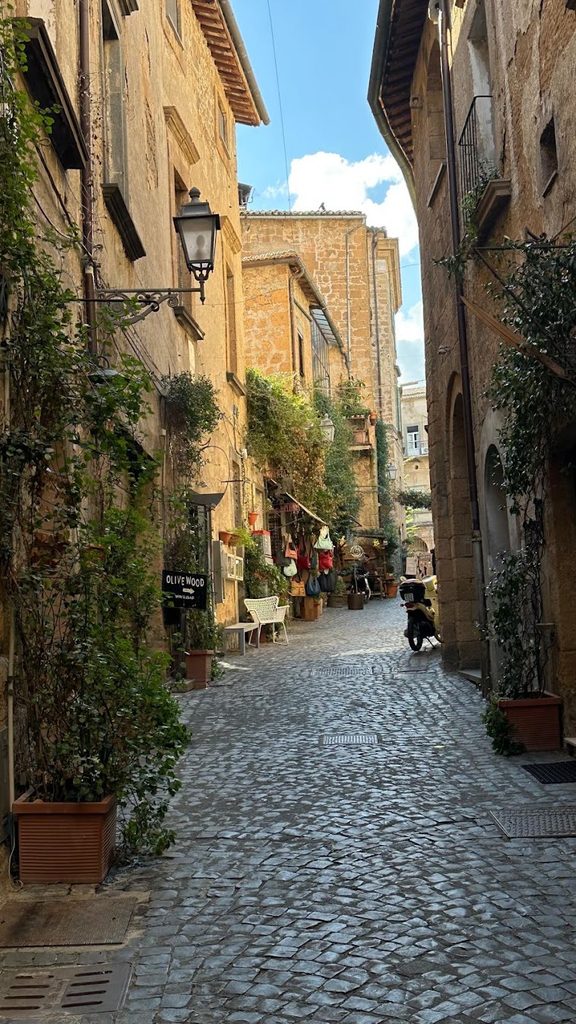
Cozy alley in Orvieto’s old town.
Once up on the hill, we continued on through cobblestone streets without getting off the bikes until we hit one of the main pedestrian thoroughfares. Here we found four other adventure bikes and took a leap of faith leaving our soft luggage behind while we trodded on in our heavy adventure boots.

The town was bustling with visitors midday on Sunday, but the tourist traffic wasn’t oppressive the way it can be in Florence. Plenty of the little streets were completely empty.
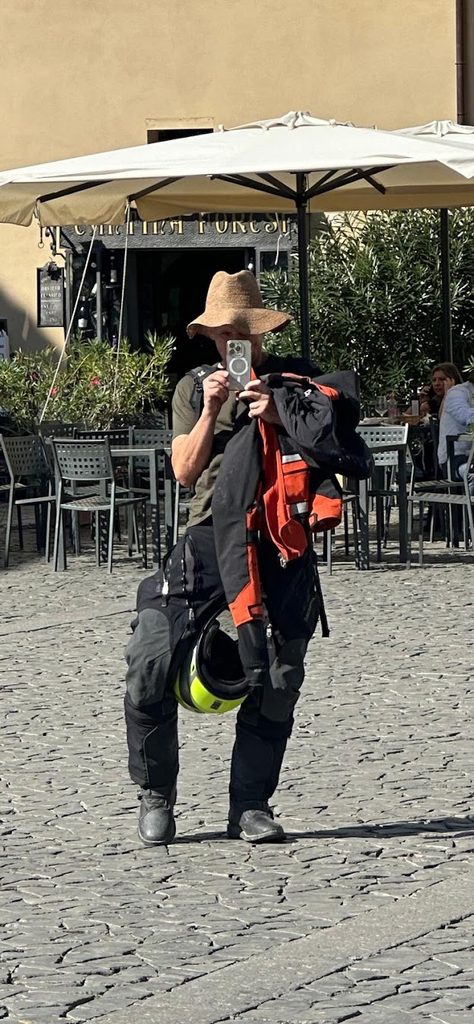
ADV cowboy-blogger in action.
Without much research we went with our gut when picking a lunch spot and hit a jackpot. Min thought it was some of the best food we had in Italy. Naturally, neither one of us remembers the name of the restaurant. There are days when middle age makes me feel like a clownfish.
The ride from Orvieto to Rome put us back on the A1 which we abandoned back in Florence. All the backroads north north of the Eternal City appeared to lead through suburbia, not worth the extra hour. As for the A1 itself, it was pretty much as busy as one would expect. The two lanes we joined around Orvieto eventually became three, the big city energy dictating the increasingly frenzy pace.

About the only visual worth noting along the way was the town of Orte which at first I mistook for Viterbo. The town was built on top of a dramatic rock formation adjacent to the the River Tiber and appears out of nowhere. Quite a sight. According to the map we had crossed over to Lazio, the capital region, only a couple kilometers earlier.
To get to our Airbnb in Portuense, Google had us follow the circular periphery and enter the city from the west. This isn’t the most attractive way to go, equivalent of slogging through Queens on the way to Manhattan, but it got us there relatively quickly and safe.
In contrast to our April adventures in Athens, finding good stables in Rome is not particularly difficult. Most garages close for a good 6-8 hours on Sunday afternoons, but we still found one within a 5 minute walk from our apartment in less than a quarter of an hour.

Rome. Back of the massive and awe inspiring Altare della Patria as seen from a bridge over the Tiber.
And riding through Rome itself? I’ll leave that for another blog entry.